Introduction
The various stages and details of Napoleon´s life in general are well known and have been described often enough. Between the early years in Corsica and the final exile in St. Helena, located in the South Atlantic, there is pure richness of life. To distinguish what is important from events of less relevance is not an easy task, since almost every moment seems to be filled with fateful significance.
According to the widespread impression, the climax in the judgement of many contemporaries and those born later was the solemn ceremony that took place in Notre-Dame de Paris on December 2, 1804, during which the most outstanding sovereign title to be awarded in the West was given to a homo novus. The coronation of Napoleon I. as Emperor of the French as part of an effective self-coronation by his own hands instead of the pope brought to a conclusion what a constitutional amendment and referendum had already prepared. As the successor to the Roman Caesars and Charlemagne, Napoleon wanted to strengthen his own legitimacy and at the same time the foundations for the installation of the dynactic principle were laid. In ancient Rome as well as in Paris at the beginning of 19h century, it was a matter of dispelling any budding thought of discredited royalty. In both cases the republican form of state was passé, but neither Augustus was a Tarquinius Superbus nor Napoleon I. a Louis XVI.
Without the previous successful campaigns under Napoleon´s supreme command, which consistently were won and thus formed the basis for the glory of the victor, the coronation ceremony, captured by Jacques-Louis David so colorfully on a large-format oil on canvas work, would hardly be understandable and otherwise would not have happened that way.

1. Jacques-Louis David, The coronation of Napoleon I. as Emperor of the French on December 2, 1804.
Art Robbery in and outside of France
Far less known and anchored in the general consciousness is the fact that nations, countries and cities of smaller or larger size which were defeated by the French armies also had to pay their tribute in a currency we take by no means for granted: in works of art. It was not about accidental finds along the way, but about the implementation of a systematic approach, which as a consequence, as part of armistice agreements as well as peace treaties, was unprecedented in history up to that point. The commissions and art commissioners who were joined with the advancing armies, well equipped with prepared lists and a good prior knowledge of what was beautiful and significant in the field of art, suitable for requisition, were breaking new ground in this respect.
New ground meant also to have something like a covered place to which the stolen objects of art were to be taken, in order to present them to an enthusiastic public as memorials to victory, as trophies: the Louvre in Paris. As the „Museum central des arts“, opened on August 10, 1793, during the high phase of the revolutionary reign of terror, a changed function of parts of the Louvre as the country´s first public museum provided a new meaning for the starving building complex, that had existed since the Middle Ages. The old fortress, which later became the royal residence, was now a place for the general public, a public representing all classes of the population, who were granted admission – initially on two days of the week, extended to ten days according to the revolutionary calendar. A first catalog listed 537 paintings and 124 sculptures, vases and other objects of art. Three-fourths of the paintings on display came from the royal collections and one-fourth from expropriated aristocracy or church property and had thus survived the revolutionary iconoclasm.
From the provenance of art that was added afterwards, one can still see fairly precisely where the French armies were currently located. During the so-called First Coalition War, the Austrian Netherlands, corresponding largely to today´s Belgium, and areas of the Holy Roman Empire of the German Nation on the left bank of the Rhine were occupied. As a result parts of the Ghent Altarpiece by Jan van Eyck, paintings by van Dyck, Rembrandt and Rubens were confiscated and taken to Paris.
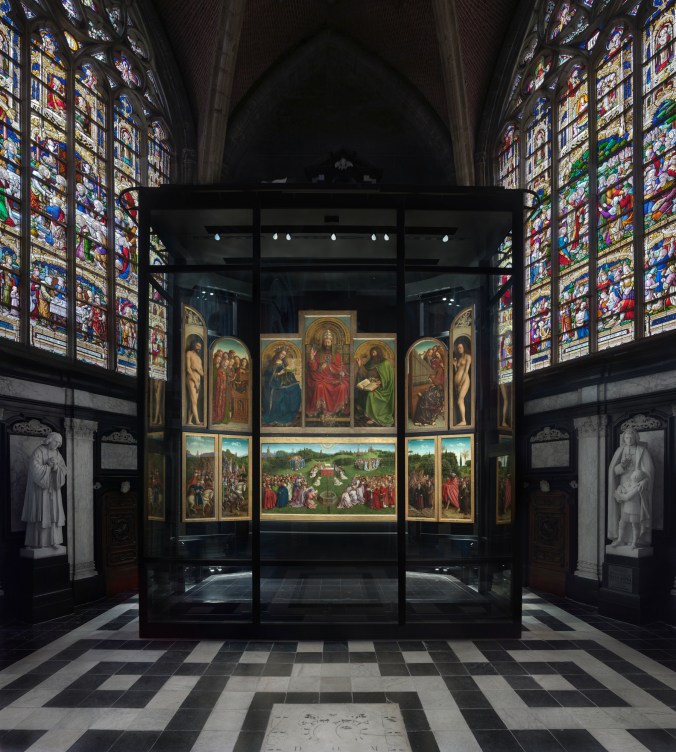
2. Jan van Eycks famous masterpiece form Ghent.
In this way in October 1794 the Church of Saint Peter in Cologne lost, among other things, the crucifixion of the Apostle Peter. Aachen a large number of late antique columns from the Palatine Chapel of the cathedral. The lieutnant and art commissioner Barbier knew how to justify the procedure as follows: „The army of the north pressed fire and sword into the midst of the tyrants and their followers. But the army carefully guarded the numerous masterpieces of art left behind by the despots in their nasty flight. (…) No longer are these immortal works in foreign land; today they have arrived in the fatherland of the arts and the genius of freedom and equality in the French Republic. I have brought together and accompanied these precious paintings, with more to come.“
The Horses of San Marco, Venice
The Maritime Republic of Venice in the 18th century had long since left its heyday. The transatlantic and maritime trade routes around the Cape of Good Hope to India and East Asia had outranked the Mediterranian long-distance traderoutes by far when the city´s Great Council declared the dissolution of the republic on May 12, 1797. Two days later the Serinissima was occupid by French troops. The accusations addressed at the Venetians that they have previously played a key role in the atrocities known as the „Veronese Easter“ against wounded members of the French military raised fears of a severe revenge.
In addition to several million gold ducats, hundreds of old manuscripts and valuable paintings, the symbols of the city par excellence had to be paid as a contribution: the lion of St. Marc´s square and the horses of San Marc. The four gilded bronze horses of San Marc have adorned the facade of the Duomo since ancient times. As part oft the Fourth Crusade they were stolen from Byzantium in 1204 during the Doganate of Enrico Dandolo in an act directed against his own fellow believers of the Eastern creed. They are said to have been set up by Emperor Constantine in the hippodrome of his new capital as part of a quadriga that has no longer been preserved. Their ancient origin is thus guaranteed, although archaeological research is struggling with an exact age determination. The dating suggestions range from the fourth BC to the first AD century. This has less to do with inaccuracy in the methods used than with the fact that the horses of San Marco are unique. With the exception of the equestrian statue of Marc Aurel, in my opinion no comparable material is known, the existence of which would enable a stylistic analysis with greater precision. There are very few life-size or larger-than-life bronze statues of ancient origin that have survived the centuries unscathed. The vast majority of them has been melted down at some point in order to produce objects such as church bells or cannons from the valuable alloy.
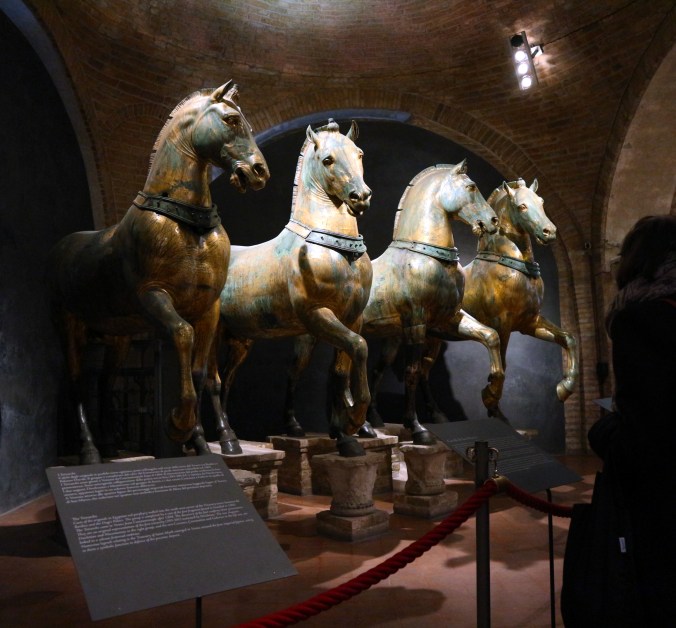
3. Made of gilded bronze: The original horses of San Marc, Venice.
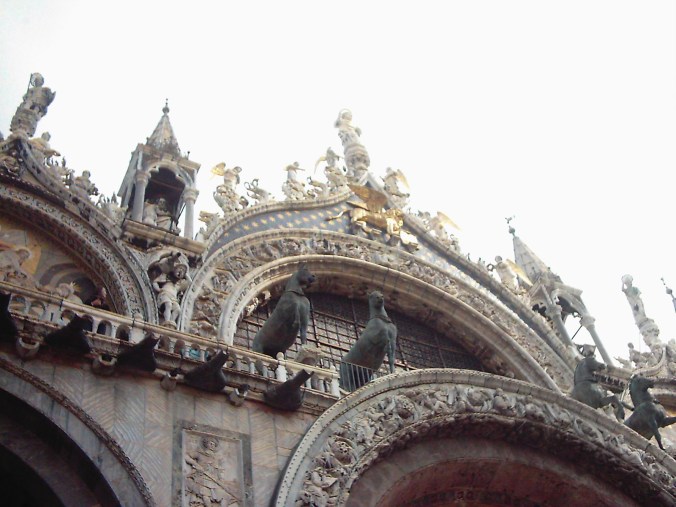
4. The horses and the facade of San Marc.
However, on July 28, 1798, in a chariot drawn by living horses, the horses of San Marco made their entry into Paris in a staging reminiscent of triumphal procession. Contemporary engravings like those shown in the „Collection complète de la Révolution française“ reproduce the spectacle.
Paris as the new Rome
Anyone moving along the historical axis of Paris, resembling a Decumanus Maximus, gets a direct idea of the extent to which Roman antiquity served as a leading role model for the late 18th and early 19th century in France. Visible architectural expression is given by the 56 meter high Arc de Triomphe de L‘ Étoile, whose foundations were laid in 1806, representing in terms of its layout a monumental variant of the Roman Arch of Titus from the time of the Flavian dynasty. So is the smaller Arc de Triomphe du Carroussel near the Louvre, that is more reminiscent to the early third-century Arch of Honor of Septimius Severus.
Of course, Italy had much more to offer experienced art thieves than the beautiful treasures of Venice. In a register that required the Papal States to hand over 100 works of art to the French, it is learned that 83 of them were Greek and Roman sculptures, many of them made of marble. These include masterpieces such as the Apollo from Belvedere or the Laocoon group. The Uffizi in Florence could not avoid having to hand over the Venus Medici. The general director of the former Musée Napoléon and today´s Louvre, Dominique-Vivant Baron Denon, thus owned the world´s most important collection of antiquities.
In German countries
The Austrian Empire, the Kingdom of Prussia, the Electorate of Hesse-Kassel and the Duchies of Brunswick and Saxe-Weimar-Eisenach were most threatened due to the lack of a pro-French political attitude. As a result Jena und Auerstedt led to the removal of huge inventories to the banks of the Seine.
The most beautiful exhibits could than be admired in an exhibition shown in the Musée Napoléon until March 1808. French art historian Bénédicte Savoy noted this in 2013: „If one poses the question of art robbery as a question of cultural transfers in the deepest sense, than there was already a positive consequence of this forced transfer of works of art. This applies particularly to the works of old German painting. When they were taken from here by the French commissars, they had no museum value. They weren’t on display. Then come to Paris. They stay in Paris for seven years and the Germans report all the time, oh, that interests the Parisians. Cranach und Dürer find them very exciting. And when these works are free again or when the moment is that you can get them back, then they are the icons of the nation. And that happened because they were gone. So in the loss you recognize your own values.“
A certainly interesting aspect, which can be supplemented by pointing out that the Hague order for the protection of enemy property only came into being at the end of the 19th century, and that the awareness of wrongdoing in this regard 80 to 100 years earlier should not have been particularly pronouced.
Nevertheless, even after Waterloo, the dilemma emphasized by Denon biographer Reinhard Kaiser persisted: „However, innumerable works of art remained in France at the time. The difficulties for the envoys of the various governments in their reclaims were considerable. Even the identification of the paintings was a tricky problem in many cases in a time without photography – less in the case of the well-known masterpieces, but still in the case of a large number of excellent paintings with often identical or easily confused and little meaningful titles, that made it only under difficulties possible to assign them to the legitimate owners again. A additional difficulty arose from the fact that the paintings in the Musée Napoléon were often exhibited under a different artist name than in their place of origin. Not to camouflage them or to cover tracks, but because the Louvre´s specialists had – often correctly – reattributed them.“
Finally
The Louvre is unique, the museum with the most visitors in the world and always worth a visit. Some of the quetions raised in my article could also be addressed to other European museums with collections built up in the 18th and/or 19th century. The discussions, by the way a never ending story, between the British Museum and representatives of Greece regarding the return of the famous Elgin Marbles, which had been picking up speed again for some time, may suffice here as evidence.
photo credit© 1, 2, 4 public domain; 3 Andraszy, CC BY-SA 4.0, unchanged;
 Des Pudels Kern
